IEEE/RSJ IROS 2026 Pittsburgh, USA Accepted

Real-Time Dynamics-Based Torque-Sampling MPPI for Compliant and Force-Aware Manipulation

Euncheol Im1,2, Taehyun Kim1,2, Yonghwan Oh1, Myo-Taeg Lim2, Yisoo Lee1,†
† Corresponding author
1Korea Institute of Science and Technology (KIST), 2Korea University

A dynamics-based torque-sampling MPPI framework that solves full rigid-body dynamics inside a real-time MPC loop, enabling compliant and force-aware manipulation at a 166 Hz solver update rate with a 0.18 s prediction horizon on a 7-DoF manipulator.

166 Hz
Solver update rate
(real robot, full rigid-body dynamics)
0.18 s
Prediction horizon
at torque level
1st
MPPI manipulation with
explicit full rigid-body dynamics
1.80 N
Force tracking MAE
on a curved contact surface

Abstract

This study proposes a novel Model Predictive Path Integral (MPPI)-based task-space control framework. The proposed framework explicitly solves rigid-body dynamics within a real-time MPC formulation and enforces safety constraints, enabling accurate motion and force control that yields compliant behaviors for safe and effective physical interaction of robotic manipulators in unstructured environments.

By leveraging MPPI, the framework efficiently handles nonlinear dynamics that are difficult to solve with conventional MPC approaches in real time. Furthermore, we develop a torque-sampling-based control architecture that enables efficient exploitation of GPU-based parallelization, resulting in effective compliant and force-aware behaviors.

As a result, the proposed framework achieves a solver update rate of over 166 Hz with a 0.18 s prediction horizon, and its performance is validated through real-world experiments on a 7-DoF manipulator (Franka Research 3).
Proposed Method

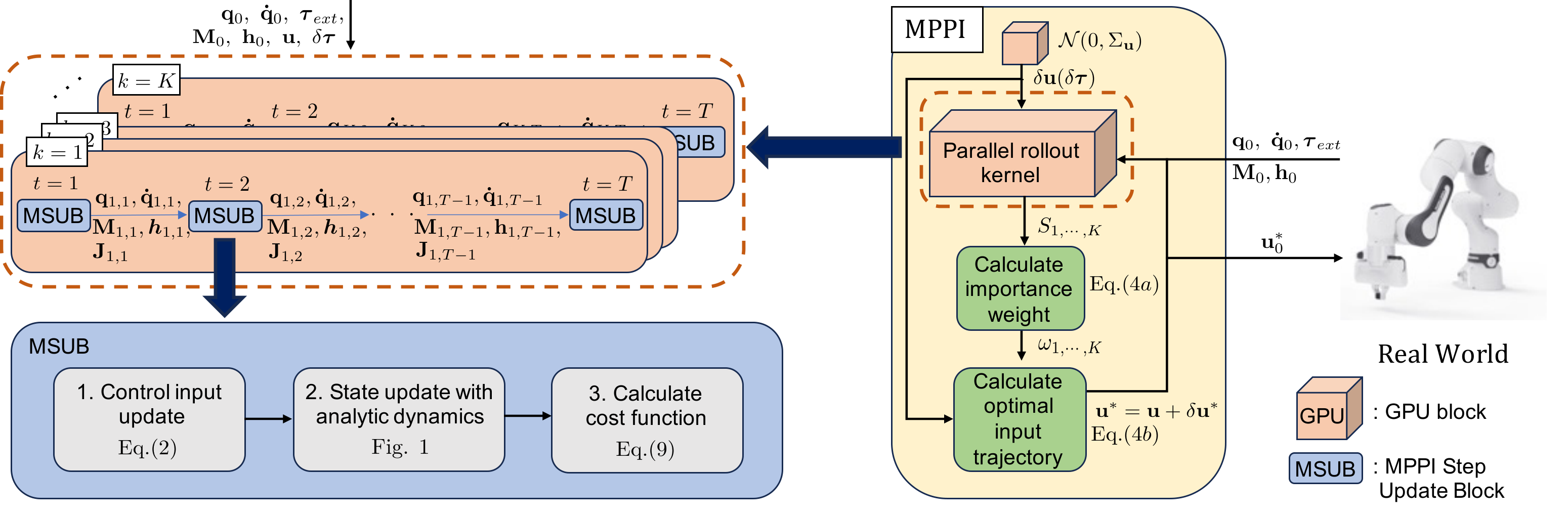
Overview of the proposed torque-sampling MPPI control structure

Control structure of the proposed method. Orange blocks run on the GPU (parallel rollouts with analytic dynamics); green blocks run on the CPU. Each MPPI Step Update Block (MSUB) computes forward dynamics and cost at every timestep for every rollout.

Dynamics-Based Torque Sampling

Unlike conventional MPPI for manipulation that samples in joint space (positions, velocities, or accelerations), the proposed method directly samples and optimizes joint torques (uk,t = τt + δτk,t).

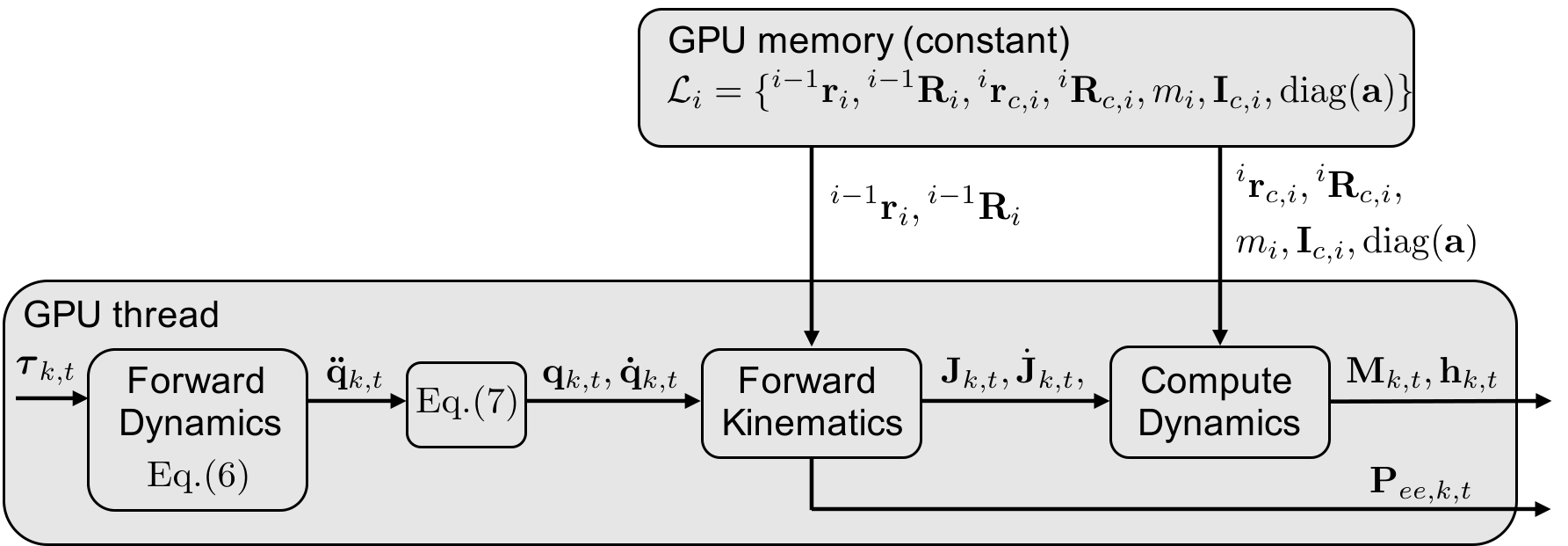
Future states are predicted by solving analytic forward dynamics M(q)q̈ + h(q,q̇) = τ + τext at every timestep of each rollout, integrated with an explicit Euler scheme.

Key advantages:

  • First MPPI manipulation framework with explicit full rigid-body dynamics
  • Torque-level control yields inherent compliance during physical interaction
  • Enables seamless integration of force-related objectives in the optimization loop
GPU-parallelized analytic dynamics solver block

Hybrid Motion–Force Cost & GPU Solver

The running cost combines motion (SE(3) position + orientation), force, and constraint terms: ℓ = Cmotion + Cforce + Cconstraint.

The detailed constraint cost formulations (joint-limit, posture, and collision) are adopted from our baseline (Kim et al., IEEE T-RO 2025).

End-effector force is estimated through the dynamically consistent generalized inverse (Fee = J̄Tτ), decoupling task-space force from null-space torques. Diagonal weights select axes for hybrid motion/force control.

Key advantages:

  • Custom CUDA kernels evaluate thousands of rollouts in parallel
  • Robot parameters stored in GPU constant memory (no inter-thread comms)
  • Joint-limit, posture, and collision costs enforce safety & feasibility
  • Up to 1,024 rollouts in real time (K = 128 used in experiments)

Experiments

Validated on a 7-DoF Franka Research 3 (FR3). GPU MPPI on a desktop PC (i9-10900KF, RTX 2070 Super), bridged to the robot via an Intel NUC over the Franka Control Interface (1 kHz) and ZeroMQ.

Comparison with Baseline

Baseline: a kinematic-based MPPI (Kim et al., IEEE T-RO 2025) that performs task-space control at the kinematic level.

Response to an external disturbance: baseline (kinematic) vs. proposed (torque-based).

Compliance vs. Safety Lock

When an external disturbance is applied, the kinematic baseline halts — its internal safety rules trigger a safety lock because the disturbance is treated as a violation.

The proposed method is torque-based, so the robot complies with the disturbance instead of resisting it. No safety lock is triggered, and manipulation continues smoothly.

Hybrid Motion–Force Control with Disturbances (Free Space)

A step reference (Fx,d = 10 N along x, with target y/z position and fixed orientation) under repeated external pushes at the end-effector:

  • Mean position error (converged): 0.0137 m
  • Mean orientation error: 0.0208 rad
  • Robot responds compliantly to pushes and returns to the desired force/pose

Force is estimated purely from torque projection (Fee = J̄Tτ) — no force/torque sensor.

Free-space hybrid motion–force control under external perturbations.

Hybrid Motion–Force Control under Maintained Contact

Maintaining contact and sliding along a curved surface (cylindrical water bottle).

Force control along z (Fz,d = −4 N) while the y-axis follows a linear trajectory on a curved surface with no prior geometric model:

  • Force tracking MAE: 1.80 N
  • Position error: 0.012 m, orientation: 0.0921 rad
  • Force-aware behavior emerges from torque sampling, no force sensor

Dynamic Obstacle Avoidance

While exerting a constant force (Fy,d = −4 N), a moving obstacle (tracked by an Intel RealSense L515) intrudes on the robot's path.

  • Robot reactively moves away, temporarily overriding the force command
  • Safety prioritized via a high collision-cost weight
  • Demonstrates real-time reactivity in dynamic environments

Collision avoidance against a dynamic obstacle during force control.

BibTeX

The full BibTeX entry will be available once the IROS 2026 proceedings are published. (Coming soon)